




ORGANS OF PARIS © 2026 Vincent Hildebrandt HOME ALL ORGANS
Saint-Sulpice
Place Saint Sulpice, 75006 ParisGallery organ
Choir organ>
Chapelle de l’assomption> Orgue ‘d’étude>

Saint-Sulpice is one of the largest churches in Paris,
only slightly smaller than Notre-Dame. It was built
on the place of a small shrine dedicated to Saint-
Sulpice-des-Champs, which dates back to the 12th
century. It was enlarged in the 14th and 16th
centuries. The construction of a new church begun
in 1646 and was not completed until 1745. The
classic Italian-style façade (1732) was designed by
Giovanni Niccolo Servandoni. The south tower was
never completed (due the the revolution).
The interior decoration of the building is typical of
neo-classical churches with its abundant statuary.
The many works of art were created by the most
talented artists of the time (Jean-Baptiste Louis-
Simon Boizot, Bouchardon, Slodtz brothers). The
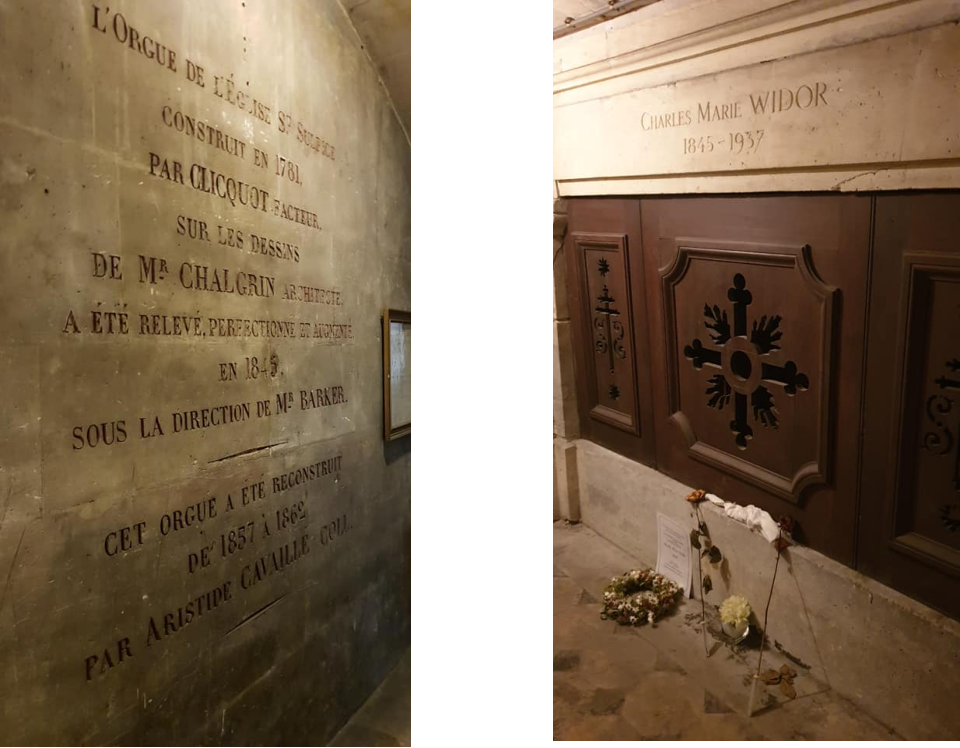
remains of Charles Marie Widor lie in the crypt.



C2
1776–1781
The grand project for a new organ of Saint-Sulpice began to
take shape in 1776. Two designs for the organ case were
submitted: the first, by architect Laurent, featured no visible
façade pipes—a new fashion at the time—while the second
was by Jean-François Chalgrin. The wardens chose Chalgrin’s
design, which they felt blended better with the large stone
gallery built by Servandoni. On January 1, 1778, a contract
was signed with master joiner Jadot (20,000 livres) and
sculptor Duret (16,000 livres) for the construction of the case.
For the organ itself, the specification was drawn up by
François-Henri Clicquot and revised by Dom François Bédos.
The building contract was signed on January 1, 1780, for a
total of 40,000 livres.
Clicquot completed the organ on April 30, 1781. It had 64
stops, five manuals, a 36-note pedalboard, and 4,328 pipes
supplied by fourteen bellows.
1834–1845
Restoration was begun by Louis Callinet in 1834. Facing
financial difficulties, he abandoned the work in 1838. The
project was then entrusted to the firm of Daublaine &
Callinet, who also failed to complete it. The work was finally
finished by organ builder Pierre-Alexandre Ducroquet and his
associate Charles Barker, who:
•
removed several mixture ranks
•
added reed stops
•
added a Barker machine.
The restored organ was received in April 1846 with 66 stops
distributed over four manuals and a German-style
pedalboard.
1855–1863
After this restoration, neither the parish nor the organist was
satisfied with the instrument. In 1855, they hired Aristide
Cavaillé-Coll to handle voicing and maintenance. Almost
immediately, he proposed a complete reconstruction while
reusing existing material.
After five years of work, Cavaillé-Coll delivered, within
Chalgrin’s case, a monumental organ of 100 stops arranged
over no fewer than seven levels.
The magnificent terraced console introduced a major
innovation: the use of Barker machines for stop action,
allowing the organist to “preset” registrations in addition to
those prepared using the double-laye system.
From Clicquot’s organ, around forty ranks were retained,
including mixtures and reeds—roughly two-thirds of the
original instrument. He also kept seven windchests,
modifying them to include a second set of valves for
improved wind supply.
From Callinet, he retained the Trompette en chamade, some
bassoons, and other reed ranks, as well as the Barker
machine, which he installed for the Récit.
All mechanical action and wind systems were rebuilt. The
wind system provided different pressures for low and high
notes in each rank, and higher pressures for the reeds than
for the foundation stops.
Each division had its own Barker machine, with one general
machine for couplers.
The Grand-Orgue spanned seven levels—from the gallery
floor to the vault—reaching a height of 18 meters (about 59
feet). Four levels contained the mechanism, and three held
the pipes.
The organ’s inauguration took place on April 29, 1863,
featuring César Franck, Camille Saint-Saëns, Alexandre
Guilmant, Auguste Bazille, and the resident organist Georges
Schmitt. That same year, at the request of Lefébure-Wély
(then newly appointed titulaire), Cavaillé-Coll added a
thunder pedal, a nightingale, and a hail machine.
1883
The first cleaning was carried out by Cavaillé-Coll himself,
with a few minor adjustments mainly to improve wind to the
Récit’s lowest pipes. Timbre notches and harmonic brakes
were also installed.
1903
Charles Mutin undertook a major restoration and
modifications at Widor’s request:
•
small adjustments in stoplist: the Positif’s Clarinet was
replaced by an 8′ Baritone, and the same division’s 8′
Euphone by a 16′ Bassoon. Three new stops were
introduced in exchange: an 8′ Diapason on the Récit, a
2 2/7′ Septième, and an 8′ Trompette en chamade on the
Solo
•
the manual order at the console was changed. While the I
Grand Chœur and II Grand-Orgue remained, the
Bombarde division (formerly on the third manual) was
moved to the fifth and renamed Solo. The Récit,
previously on the fifth, was moved to the fourth manual,
and the Positif, originally on the fourth, was moved to the
third.
1933
Widor’s only criticism was that the Pedal division remained
too weak with only twelve stops. Upon his retirement in
1933, the parish gifted him two additional pedal stops—a 16′
and an 8′ Principal—installed by Pleyel-Cavaillé-Coll outside
the case on pneumatic chests.
1988–1991
Jean Renaud carried out a thorough dust cleaning of the
instrument, carefully preserving its historical authenticity.
2000
Overhaul by Swiderski.
Nearly half the pipework dates from 1781. About 31 complete
ranks were built by Cavaillé-Coll. The Grand-Orgue, Bombarde,
and Pedal windchests are by Clicquot, later adapted for the
Grand Chœur and Grand-Orgue (“restored original windchests”).
The Positif chest became that of the expressive Récit.
In 1781, the manuals had 56 notes (AA–e³), allowing Cavaillé-Coll
to extend them to C–g³.
The 1845 Barker machine was reused for the Récit; for the other
manuals and stop action, Cavaillé-Coll built new Barker
machines.
The pedal division retained some Daublaine-Callinet stops (16′
Contrebasse and 16′ Basson); the other reeds were by Clicquot.
The 8′ Ophicléide is the former second 8′ Trompette; the C–F
pipes of the 32′ Bombarde are by Cavaillé-Coll.
When the new 435 Hz diapason pitch was introduced in 1859,
much of the pipework had to be revoiced accordingly.
(Source: René Verwer, De Orgelvriend)
Site of the organ


1781 - Clicquot (1)
1834-1845 - Daublaine-Callinet-Ducroquet (5)
1862 - Cavaillé-Coll (3a)
1883 - Cavaillé-Coll (6)
1903 - Mutin (5)
1933 - Société Cavaillé-Coll (2)
1991 - Renaud (5)
2000 - Swiderski (6)
V/102 - mechanical traction
Stoplist


Titular organist
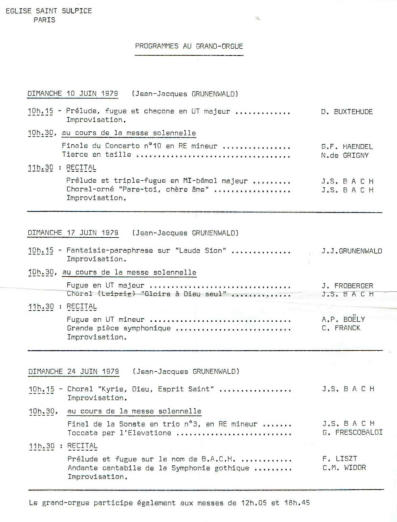
Sophie-Véronique Cauchefer-Choplin & Karol Mossakowski, titulaires du grand-orgue Daniel Roth, titulaire émérite du grand-orgue Axel de Marnhac, titulaire de l’orgue de choeur Anciens organistes titulaires : Guillaume-Gabriel Nivers (1651 - 1702) J.B. Totin (1702 - ca. 1714) Louis-Nicolas Clérambault (1715-1749) César François Clérambault (1749 - 1760) Evrard Dominique Clérambault (1761 - 1773) Claude Etienne Luce (1773 - 1783) Nicolas Séjan (1783 - 1819) Louis Nicolas Séjan (1819 - 1849) Georges Schmitt (1850 - 1863) Louis-James-Alfred Lefebure-Wely (1863 - 1869) Charles-Marie Widor (1870 - 1934) Marcel Dupré (1934 - 1971) Jean-Jacques Grunenwald (1973 - 1982) Concerts Parish website Videos Karol Mossakowski Sophie-Véronique Cauchefer-Choplin Sophie Veronique Cauchefer Choplin Daniel Roth Audio Sophie-Véronique Cauchefer-Choplin Sophie-Véronique Cauchefer-Choplin Sophie-Véronique Cauchefer-Choplin Feike Asma (Widor) Jean-Jacques Grunenwald Jean-Jacques Grunenwald Jean-Jacques Grunenwald Marcel Dupré Photos Buffet : Jeroen de Haan Les autres photos : Victor Weller








The organs of Paris
Saint-Sulpice
Place Saint Sulpice, 75006 ParisGallery organ
Choir organ>
Chapelle de l’assomption> Orgue ‘d’étude>


ORGANS OF PARIS © 2026 Vincent Hildebrandt
C2
1776–1781
The grand project for a new organ of Saint-Sulpice began to
take shape in 1776. Two designs for the organ case were
submitted: the first, by architect Laurent, featured no visible
façade pipes—a new fashion at the time—while the second
was by Jean-François Chalgrin. The wardens chose Chalgrin’s
design, which they felt blended better with the large stone
gallery built by Servandoni. On January 1, 1778, a contract was
signed with master joiner Jadot (20,000 livres) and sculptor
Duret (16,000 livres) for the construction of the case.
For the organ itself, the specification was drawn up by
François-Henri Clicquot and revised by Dom François Bédos.
The building contract was signed on January 1, 1780, for a
total of 40,000 livres.
Clicquot completed the organ on April 30, 1781. It had 64
stops, five manuals, a 36-note pedalboard, and 4,328 pipes
supplied by fourteen bellows.
1834–1845
Restoration was begun by Louis Callinet in 1834. Facing
financial difficulties, he abandoned the work in 1838. The
project was then entrusted to the firm of Daublaine & Callinet,
who also failed to complete it. The work was finally finished by
organ builder Pierre-Alexandre Ducroquet and his associate
Charles Barker, who:
•
removed several mixture ranks
•
added reed stops
•
added a Barker machine.
The restored organ was received in April 1846 with 66 stops
distributed over four manuals and a German-style
pedalboard.
1855–1863
After this restoration, neither the parish nor the organist was
satisfied with the instrument. In 1855, they hired Aristide
Cavaillé-Coll to handle voicing and maintenance. Almost
immediately, he proposed a complete reconstruction while
reusing existing material.
After five years of work, Cavaillé-Coll delivered, within
Chalgrin’s case, a monumental organ of 100 stops arranged
over no fewer than seven levels.
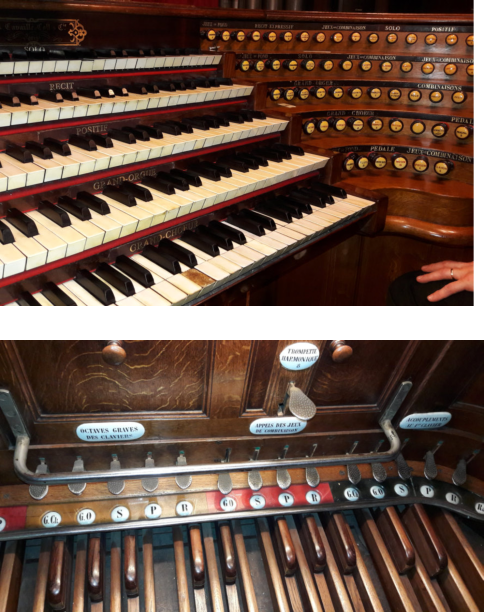
The magnificent terraced console introduced a major
innovation: the use of Barker machines for stop action,
allowing the organist to “preset” registrations in addition to
those prepared using the double-laye system.
From Clicquot’s organ, around forty ranks were retained,
including mixtures and reeds—roughly two-thirds of the
original instrument. He also kept seven windchests, modifying
them to include a second set of valves for improved wind
supply.
From Callinet, he retained the Trompette en chamade, some
bassoons, and other reed ranks, as well as the Barker
machine, which he installed for the Récit.
All mechanical action and wind systems were rebuilt. The
wind system provided different pressures for low and high
notes in each rank, and higher pressures for the reeds than
for the foundation stops.
Each division had its own Barker machine, with one general
machine for couplers.
The Grand-Orgue spanned seven levels—from the gallery
floor to the vault—reaching a height of 18 meters (about 59
feet). Four levels contained the mechanism, and three held
the pipes.
The organ’s inauguration took place on April 29, 1863,
featuring César Franck, Camille Saint-Saëns, Alexandre
Guilmant, Auguste Bazille, and the resident organist Georges
Schmitt. That same year, at the request of Lefébure-Wély
(then newly appointed titulaire), Cavaillé-Coll added a thunder
pedal, a nightingale, and a hail machine.
1883
The first cleaning was carried out by Cavaillé-Coll himself, with
a few minor adjustments mainly to improve wind to the Récit’s
lowest pipes. Timbre notches and harmonic brakes were also
installed.
1903
Charles Mutin undertook a major restoration and
modifications at Widor’s request:
•
small adjustments in stoplist: the Positif’s Clarinet was
replaced by an 8′ Baritone, and the same division’s 8′
Euphone by a 16′ Bassoon. Three new stops were
introduced in exchange: an 8′ Diapason on the Récit, a
2 2/7′ Septième, and an 8′ Trompette en chamade on the
Solo
•
the manual order at the console was changed. While the I
Grand Chœur and II Grand-Orgue remained, the
Bombarde division (formerly on the third manual) was
moved to the fifth and renamed Solo. The Récit, previously
on the fifth, was moved to the fourth manual, and the
Positif, originally on the fourth, was moved to the third.
1933
Widor’s only criticism was that the Pedal division remained
too weak with only twelve stops. Upon his retirement in 1933,
the parish gifted him two additional pedal stops—a 16′ and an
8′ Principal—installed by Pleyel-Cavaillé-Coll outside the case
on pneumatic chests.
1988–1991
Jean Renaud carried out a thorough dust cleaning of the
instrument, carefully preserving its historical authenticity.
2000
Overhaul by Swiderski.
Nearly half the pipework dates from 1781. About 31 complete
ranks were built by Cavaillé-Coll. The Grand-Orgue, Bombarde,
and Pedal windchests are by Clicquot, later adapted for the
Grand Chœur and Grand-Orgue (“restored original windchests”).
The Positif chest became that of the expressive Récit.
In 1781, the manuals had 56 notes (AA–e³), allowing Cavaillé-Coll
to extend them to C–g³.
The 1845 Barker machine was reused for the Récit; for the other
manuals and stop action, Cavaillé-Coll built new Barker
machines.
The pedal division retained some Daublaine-Callinet stops (16′
Contrebasse and 16′ Basson); the other reeds were by Clicquot.
The 8′ Ophicléide is the former second 8′ Trompette; the C–F pipes
of the 32′ Bombarde are by Cavaillé-Coll.
When the new 435 Hz diapason pitch was introduced in 1859,
much of the pipework had to be revoiced accordingly.
(Source: René Verwer, De Orgelvriend)
Site of the organ

1781 - Clicquot (1)
1834-1845 - Daublaine-Callinet-Ducroquet (5)
1862 - Cavaillé-Coll (3a)
1883 - Cavaillé-Coll (6)
1903 - Mutin (5)
1933 - Société Cavaillé-Coll (2)
1991 - Renaud (5)
2000 - Swiderski (6)
V/102 - mechanical traction
Stoplist
Titular organist
Sophie-Véronique Cauchefer-Choplin & Karol Mossakowski, titulaires du grand-orgue Daniel Roth, titulaire émérite du grand-orgue Axel de Marnhac, titulaire de l’orgue de choeur Anciens organistes titulaires : Guillaume-Gabriel Nivers (1651 - 1702) J.B. Totin (1702 - ca. 1714) Louis-Nicolas Clérambault (1715-1749) César François Clérambault (1749 - 1760) Evrard Dominique Clérambault (1761 - 1773) Claude Etienne Luce (1773 - 1783) Nicolas Séjan (1783 - 1819) Louis Nicolas Séjan (1819 - 1849) Georges Schmitt (1850 - 1863) Louis-James-Alfred Lefebure-Wely (1863 - 1869) Charles-Marie Widor (1870 - 1934) Marcel Dupré (1934 - 1971) Jean-Jacques Grunenwald (1973 - 1982) Concerts Parish website Videos Karol Mossakowski Sophie-Véronique Cauchefer-Choplin Sophie Veronique Cauchefer Choplin Daniel Roth Audio Sophie-Véronique Cauchefer-Choplin Sophie-Véronique Cauchefer-Choplin Sophie-Véronique Cauchefer-Choplin Feike Asma (Widor) Jean-Jacques Grunenwald Jean-Jacques Grunenwald Jean-Jacques Grunenwald Marcel Dupré Photos Buffet : Jeroen de Haan Les autres photos : Victor Weller

